Wednesday, January 27, 2010

Entering the era of "SURFACE" computing : MICROSOFT SURFACE


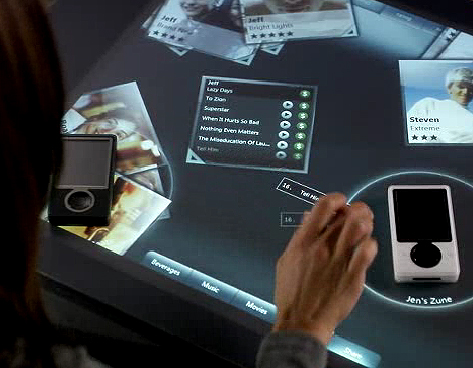
Well folks every year IIT techfest exhibits latest tech-products. But this year saw a very different tech-baby from Microsoft. It was called Microsoft Surface. Imagine a hotel wherein you check in and see a normal table with a screen on it and you see the menu on the table can just drag fingers and select the menu items, moreover just place the credit card and automatically the payment is made.Stop imagining, because its all done in MICROSOFT SURFACE. Not only in hotels but many places just drag things with fingers and your work is done.
Microsoft Surface is a multi touch device from microsoft to manipulate the digital content using gesture recognition. Isn't that cool ! A whooping 52 different touches are recorded by the device at a moment. Such a surface computing device was very unique and I decided to know more about it .
Surface was codenamed 'Milan' and was launched on April 17, 2008. It was used in 2008 US presidential elections, CSI : Miami series and many more sci-fi series. Now, I came to know what type of technology Steven Spielberg or James Cameroon etc. used. Now it is used in AT&T stores, Disneylands future home exhibits, chain of sheraton hotels etc. Surface showcases the kind of technology and devices we can come across in very near future. I totally see automated homes, marts, hospitals in near future.
The technology allows non-digital objects to be used as input devices. In one example, a normal paint brush was used to create a digital painting in the software.This is made possible by the fact that, in using cameras for input, the system does not rely on restrictive properties required of conventional touchscreen or touchpad devices such as the capacitance, electrical resistance, or temperature of the tool used.The computer's "vision" is created by a near-infrared, 850-nanometer-wavelength LED light source aimed at the surface. When an object touches the tabletop, the light is reflected to multiple infrared cameras with a net resolution of 1024 x 768, allowing it to sense, and react to items touching the tabletop.
Coming to some of its technical details. Surface has a special edition of Windows Vista operating system. Currently it has 1) Intel Core 2 Duo @ 2.13GHz (normal motherboard)
2) 2GB DDR2 RAM 3)250GB SATA Hard Drive and soon microsoft promises to upgrade it to 1) Intel Core Quad Xeon "WoodCrest" @ 2.66GHz with a custom motherboard form factor about the size of two ATX motherboards.2) 4GB DDR2-1066 RAM 3)1TB 7200RPM Hard Drive. Surface is a 30-inch (76 cm) display in a table-like form factor, 22 inches (56 cm) high, 21 inches (53 cm) deep, and 42 inches (107 cm) wide. The Surface tabletop is acrylic, and its interior frame is powder-coated steel. The software platform runs on a custom version of Windows Vista and has wired Ethernet 10/100, wireless 802.11 b/g, and Bluetooth 2.0 connectivity. Hmm, coming to the price issue, its a bit costly. A commercial Microsoft surface costs about $12500 (5,62,500 INR (exchange rate 45)) whereas a developer Surface costs $15000(6,75,000INR(exchange rate 45)).Microsoft promises to decrease the prices but how much is an issue :P
Even if the device is new, the development tools are the one's used previously. Yes, the development of Surface applications is done on WPF(Windows Presentation Foundation) and
XNA. Soon developers will have an altogether different cup of tea to develop. I think developing Surface applications will be fun because even if its reel, surely it is going to be very close to real.
Hope to see Surfaces all around !

Saturday, December 26, 2009

ADOBE AIR- The Revolution has just started.


Adobe Air or the Adobe (pronounced as uh-doe-be) Integrated Runtime is developed by Adobe System for building Rich Internet Applications.
The AIR can be integrated with other products of Abode using proper extensions, and even with html, JavaScript, Ajax(asynchronous java and xml).They are combined using AIR and their huge libraries to make desktop or Internet Applications.
So, you must be thinking about Rich Internet Applications and desktop application, what’s the difference exactly?---The Answer is here---A Rich Internet Application is deployed in a browser does not require installation, while one deployed with AIR requires the application be packaged, digitally signed, and installed to the user's local file system and run as a desktop application.

Abode Air was launched with the name Apollo along with SDK on March 19, 2007. It was renamed to AIR and was released with beta 2 of SDK on October 1, 2007. After, that many versions came along and the latest is AIR 1.5.3 launched on December 8th, 2009.

Recently I got a chance to work on Adobe Air and made an application which monitors the status of networks and their details like uptime/downtime. The application is useful for network administrator to keep a check. It could have been extended to receive text message if any network goes down and can be also connected to twitter. It was made using Html, JavaScript and CSS for Techfest in IIT Powai.

Sunday, December 20, 2009

PhysX by Nvidia

A graphics card is an inherent component of any computer. It’s the hardware that has the responsibility of creating and putting up images onto the display. Normal, everyday things that are done on a computer don’t require high performing graphic cards. But when it comes to modern games, graphic cards have a huge task cut out for them. Modern video card companies (like Nvidia, ATI technologies, Intel, Realtek and many more)devote special attention to this gaming aspect, churning out high performance graphic cards which deliver a surreal gaming experience. This is where the term ‘hardware acceleration’ and consequently PhysX by Nvidia comes into picture. What follows is a must read for fellow gamers.

PhysX is a proprietary real-time physics engine middleware software development kit … blah... blah... blah….. . Simply put, it is a middleware that does the physics calculations involved in games, for the CPU, thus allowing the CPU much needed runtime memory to perform other tasks instead. This results in less frequent lags and hence a smoother game experience. This being hardware acceleration, is supported only by certain graphic cards. Also, only PhysX enabled games can be accelerated. But realizing its promising prospects, game developers are heavily investing in this technology, and bringing out more and more PhysX enabled games, because these middleware physics engines help in avoiding writing separate codes to handle the complex physics interactions involved in games.

Now coming to its history, PhysX as a software development kit was acquired by Aegia which itself was acquired by Nvidia in Feb 08. Then, Nvidia began integrating the engine into their CUDA framework. In August 08, Nvidia released drivers that allow GeForce 8 and above series graphic cards to implement PhysX.

Intel had also been working on hardware acceleration technology, but cancelled its project, named Havok FX. So, that leaves us with only PhysX as the sole available solution for physics hardware acceleration. Supported cards are, as mentioned before, CUDA-enabled GeForce GPU cards by Nvidia. We have tested PhysX acceleration on Nvidia GeForce G105M CUDA. A large pool of games are supported by PhysX. Some of them are Batman : Arkham Asylum, Crazy Machines II, Cryostasis, Mirror’s Edge and many more .

Monday, December 14, 2009

Welcome to TechQuantum

A huge welcome to all the budding engineers, wannabe scientists, geeks, gadgets-freaks, gizmo maniacs, and whoever else who has even a wee-bit of curiosity bubbling in him/her. TechQuantum sincerely invites you all to be a part of this new space, a space where a platter of innovative, upcoming or even established, but remarkable, new technologies would be served, in the very simplest of gists, just for you to savour. Every new idea’s evolution, it’s expanse and it’s prospects would be discussed. This technology need not be necessarily be computer-oriented, it can be anything; the dictionary itself defines technology as – the scientific application of knowledge. We here, at TechQuantum, starting from this month, are going to put forth ‘packets’ of such new techs – a quantum each week.

Also, it goes without saying that recommendations are always welcome from our fellow readers. Together, we can talk on any innovation that holds promise. A new idea, a new innovation, a new possibility, a whole new vista.